Solution
One platform.
Outcomes hospital leaders care about.
From patient intake to discharge, HIKMA connects hospital teams, systems, and approved workflows to improve clinical and operational performance, without replacing your existing technology.
The problem
Disconnected systems. Manual coordination. Fragmented communication.
Hospitals often rely on disconnected systems, manual coordination, and fragmented communication. This creates delays, increases administrative workload, and makes the patient journey harder to manage. HIKMA connects these activities into one coordinated operational layer.
How HIKMA works
Four moves. Every hospital, every day.
Connect
Integrates with existing EMR, HIS, laboratory, pharmacy, and other hospital systems.
Coordinate
Turns approved clinical and operational decisions into assigned actions across departments.
Monitor
Tracks tasks, delays, escalations, and patient progress in real time.
Optimize
Provides analytics that help leaders improve workflows, capacity, and performance.
The patient journey
The patient journey,
end to end.
Every stage is tracked, time-stamped, and auditable. Delays and incomplete actions can be identified and escalated.
Intake
Patient information is captured and a structured encounter is created.
Clinical review
HIKMA prepares relevant information and suggestions; the clinician remains responsible for the decision.
Authorization
Required payer and administrative approvals are tracked.
Orders and coordination
Approved orders are sent to connected hospital systems and assigned to the relevant teams.
Discharge
Medication, education, billing, follow-up, and other discharge requirements are coordinated.
Close-out
Coding, claims, documentation, and follow-up actions are completed and tracked.
Outcomes
Outcomes that matter to hospital leaders.
HIKMA improves the measures hospital leaders monitor every day.
60 minutes faster discharge
By coordinating discharge activities in parallel and escalating incomplete steps.
3 hours of nursing coordination time recovered per shift
By reducing manual follow-up and improving structured handovers.
25% improvement in bed turnover
By accelerating discharge coordination and releasing beds earlier.
Reduced avoidable length of stay
By identifying discharge barriers, pending actions, and delays earlier.
Reduced time-to-bed
By improving bed availability and providing clearer visibility of capacity.
Reduced preventable claim denials
By supporting coding, pre-authorisation, and documentation checks before submission.
These outcomes reflect what HIKMA is designed to improve. Actual results vary by hospital, baseline performance, workflow scope, and deployment model.
Workflow areas
40+ configurable workflows. Traceable by design.
HIKMA supports configurable workflows across eight hospital areas. Each action can be tracked, reviewed, and audited. The platform is designed to reduce manual work, identify potential issues earlier, and help teams manage avoidable delays.
AI agents
Specialized AI agents. Every agent in service of a workflow you run today.
HIKMA uses specialized AI agents for defined clinical and operational tasks. Each agent operates within approved workflows and can be enabled, paused, or replaced under hospital control. HIKMA is the coordination platform. AI agents perform specific approved tasks within it.
HIKMA can support different approved AI providers based on language, use case, deployment model, and hospital requirements. The hospital retains control over which capabilities are active.
Operational analytics
Real-time dashboards. Data-driven decisions.
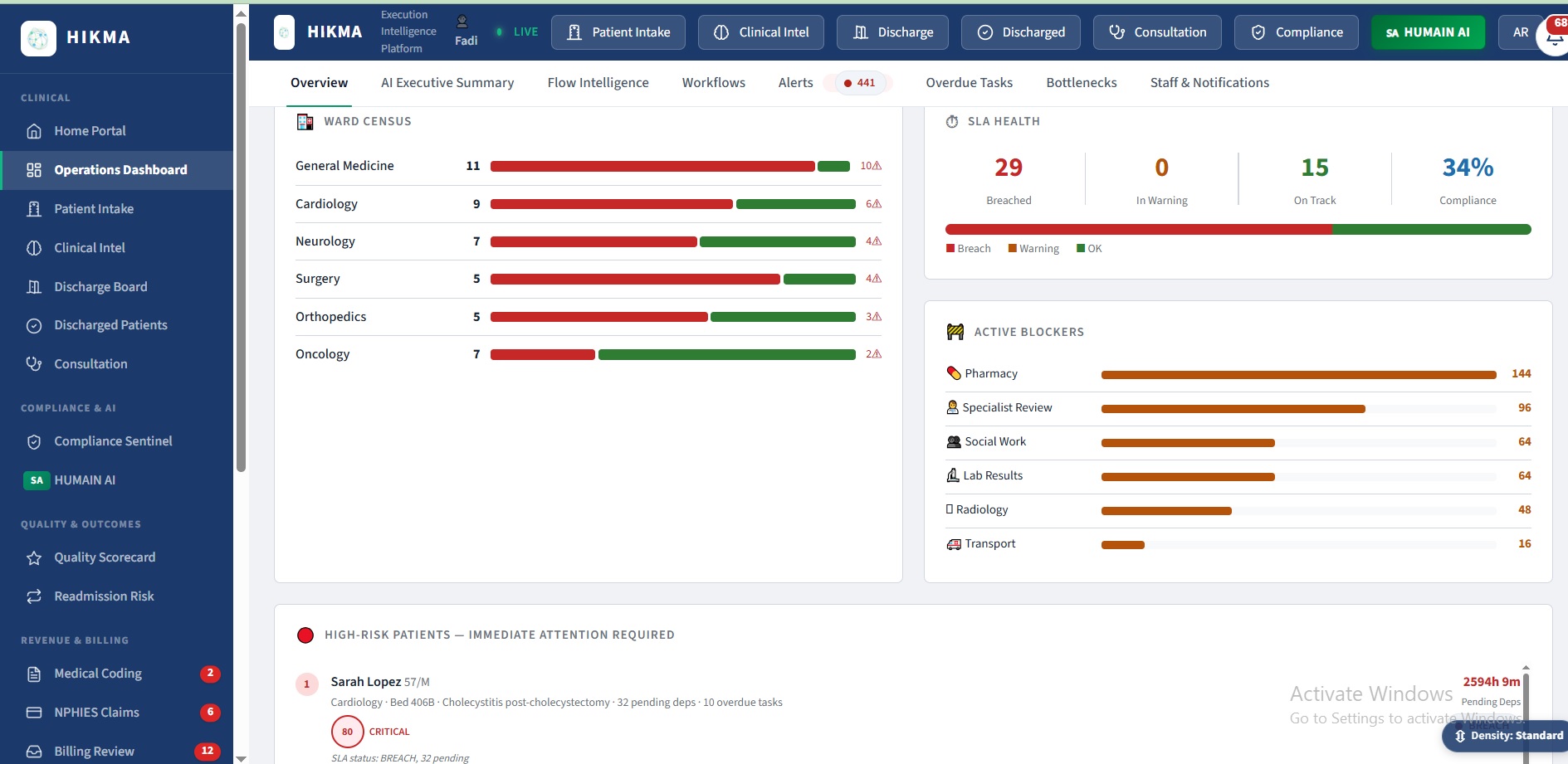
Real-time dashboards help hospital leaders track workflow completion, patient progression, bottlenecks, workload, and operational performance across departments.
Integrations and standards
Built to support healthcare standards and regional requirements.
HIKMA is designed to work with widely used healthcare data, coding, interoperability, and reimbursement standards. Availability may vary by deployment and country.
Interoperability
- FHIR R4
- HL7 v2
Clinical terminology
- LOINC
- RxNorm
Coding and reimbursement
- ICD-10-AM
- AR-DRG
- HCPCS
Regional integration
- NPHIES
- Local controlled-drug requirements
Responsible AI, privacy, and governance
Transparent, secure, always under human control.
AI supports. Clinicians decide.
AI provides information and workflow support. Clinical decisions remain with authorized healthcare professionals.
Data governed by the hospital.
Deployment, access, retention, and data-handling controls are defined with each hospital and aligned with applicable requirements.
Designed for smooth integration.
HIKMA works with existing hospital systems to reduce disruption during implementation.
Transparent and auditable.
Recommendations, approvals, actions, and workflow events can be logged and reviewed according to the configured governance model.
Role-based access.
Users only access the functions and information permitted by their assigned roles.
Deployment approach
A phased path that fits your hospital.
HIKMA is implemented in phases, with each step agreed with hospital leadership before the next begins.
- 01
Assessment and integration planning
- 02
Connection to existing hospital systems
- 03
Workflow configuration with clinical and operational teams
- 04
Controlled rollout by unit
- 05
Continuous review with hospital leadership